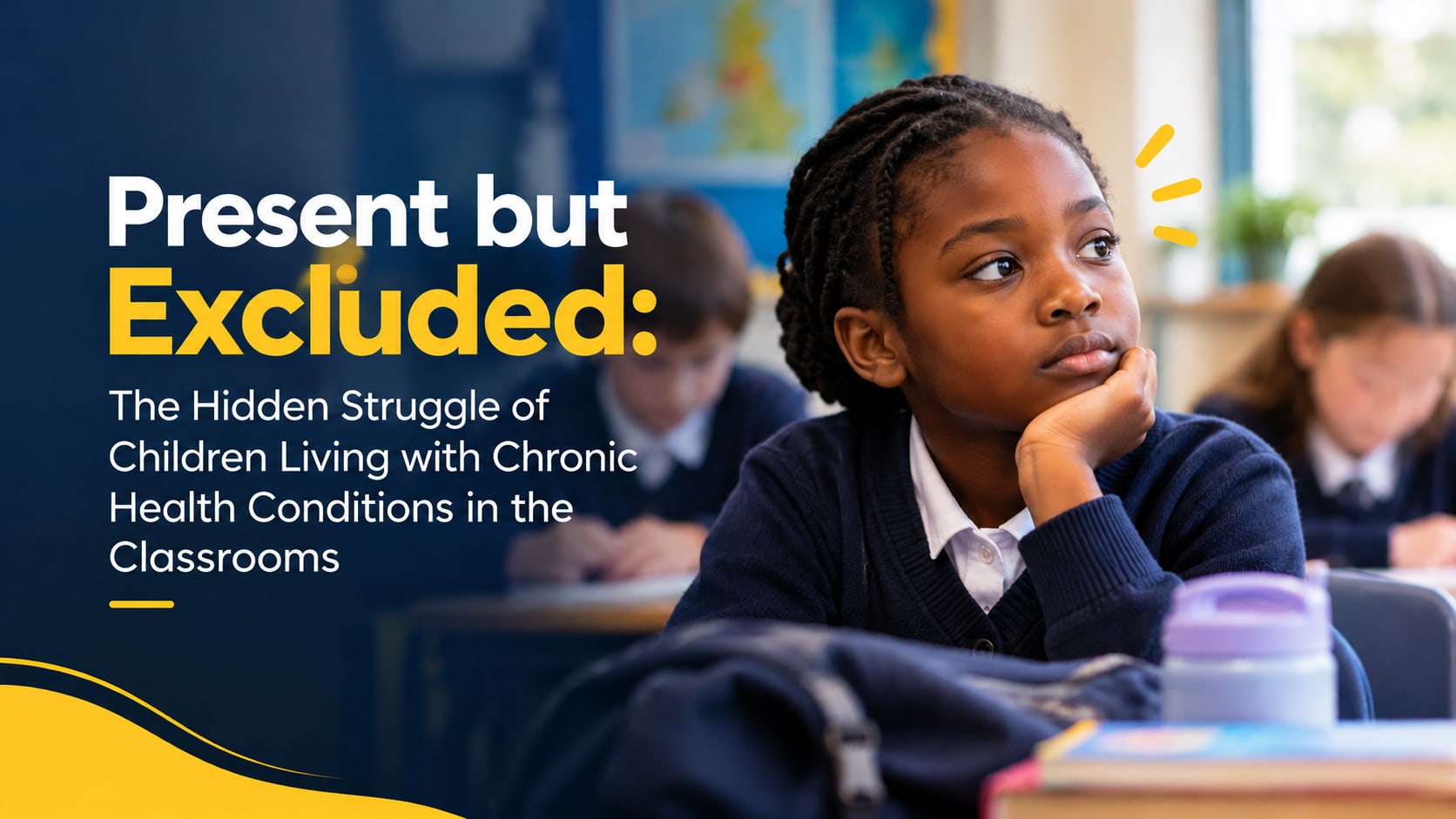
Why school attendance alone cannot tell us whether a child is genuinely included, and why educational wellbeing deserves greater attention.
A child may be physically present in a classroom yet feel isolated, unsupported and excluded.
Every morning, thousands of children across the United Kingdom prepare for school. For many, the routine is straightforward: get dressed, attend lessons, meet friends and return home. But for children living with chronic health conditions, the journey through education can be considerably more complicated.
Imagine a 13-year-old student returning to school after several weeks of medical treatment. The school records their attendance, teachers welcome them back, and their name reappears on the classroom register. By conventional measures, the student has successfully returned to education.
Yet beneath this apparent success lies a different reality. Lessons have been missed, friendships have changed, assignments have accumulated, and the student may still be managing pain, fatigue or anxiety about their health.
The student is physically present, but their experience raises a fundamental question: Does being in school necessarily mean being included?
This question deserves serious attention from educators, healthcare professionals, policymakers and families.
What the evidence tells us
Research increasingly demonstrates that chronic health conditions can create substantial barriers to educational participation.
A 2025 study published in the Journal of Public Health by Jay and colleagues, drawing on linked health and education records covering approximately 1.46 million children in England, reported that 25.9% of pupils with identified chronic health conditions experienced persistent school absence at ages 15–16, compared with 14.7% of pupils without identified conditions.
This represents approximately 1.8 times the rate of persistent absence.
The wider national picture is equally concerning. According to Department for Education statistics for the 2024/25 academic year, 18.14% of pupil enrolments in England were persistently absent, representing approximately 1.34 million enrolments. Illness accounted for 3.22% of all possible school sessions.
Although these statistics measure different populations and should not be directly equated, they demonstrate the scale of school absence and the importance of understanding the circumstances behind it.
However, statistics reveal only part of the story.
An attendance register can identify when a student is absent, but it cannot adequately explain whether the student feels connected to classmates, receives appropriate educational adjustments or has a meaningful voice in decisions about their learning.
We have become increasingly sophisticated at measuring school attendance. But have we become equally effective at measuring educational belonging?
When the classroom becomes another barrier
For children living with sickle cell disease, epilepsy, diabetes, cancer and other long-term conditions, school participation may be shaped by medical appointments, treatment schedules, fluctuating symptoms and periods of unavoidable absence.
Some children experience difficulties concentrating because of fatigue. Others struggle to participate in physical activities, complete assignments within standard deadlines or maintain consistent social relationships.
The challenges are not always visible.
A student who appears disengaged may be managing significant discomfort. Another who frequently requests rest breaks may be experiencing symptoms that classmates and teachers do not fully understand.
Without appropriate support, these experiences can create an unintended cycle: illness leads to absence, absence creates learning gaps, learning gaps increase anxiety, and anxiety can make returning to school more difficult.
Research by Herlitz and colleagues (2025) and Hopwood and colleagues (2024) highlights the importance of understanding children's experiences of health-related absence, school attendance and reintegration.
Their work reinforces a crucial distinction: educational access is not the same as meaningful educational participation.
A child may have a place in a school without feeling that they belong to its learning community.
Why inclusion must go beyond physical attendance
Traditional discussions about educational inclusion often focus on ensuring that children can access mainstream classrooms.
While physical access remains important, children with chronic health conditions may require a broader understanding of inclusion.
For some, meaningful participation involves attending school with reasonable adjustments. For others, it may involve hospital education, home teaching, adapted timetables or appropriately supported remote learning.
The objective should not be to insist that every child learns in exactly the same way, but to ensure that every child has a realistic opportunity to learn, participate and maintain social connections.
This requires a shift from asking only whether a child is attending school to examining the quality of the educational experience available to them.
A student who receives appropriate academic support but remains socially isolated may still experience exclusion. Similarly, a child receiving education at home may be progressing academically while losing important connections with friends and classmates.
Educational inclusion must therefore consider both learning and wellbeing.
What schools can do differently
Supporting children with chronic health conditions does not always require radical institutional change. Often, meaningful improvements begin with how schools understand and respond to individual needs.
First, schools should recognise that a diagnosis does not tell the whole story. Two children with the same medical condition may have very different educational experiences. Individualised support, developed collaboratively with children, families and relevant healthcare professionals, can help identify appropriate adjustments.
Second, flexibility should be treated as a legitimate component of inclusive education rather than an exception granted reluctantly. Adapted workloads, reasonable deadlines, rest opportunities and accessible learning resources can enable participation without placing unnecessary pressure on a child's health.
Third, schools must recognise the importance of relationships. Education is not simply the transmission of knowledge; it is also where children develop friendships, confidence, identity and a sense of belonging. Maintaining appropriate peer contact during prolonged absence and supporting social reintegration can be as important as helping students catch up academically.
Fourth, children must be heard.
A student living with a chronic condition should have opportunities to explain what makes learning difficult, what support they find helpful and how they would prefer to participate.
Instead of asking only, "When can this child return to full-time attendance?", schools might ask, "What educational arrangement would enable this child to learn safely, confidently and meaningfully?"
Finally, collaboration between education and healthcare must improve. Teachers should not be expected to make medical decisions, just as families should not have to navigate fragmented educational arrangements without clear support.
In England, Section 19 of the Education Act 1996 establishes duties concerning suitable education for children who cannot attend school because of illness or other qualifying reasons. Department for Education statutory guidance provides further direction on educational arrangements for children with health needs.
The challenge is ensuring that legal responsibilities translate into timely and meaningful experiences for children.
Rethinking inclusion through the CARE Framework
These concerns are central to my ongoing research into educational inclusion and wellbeing for children with chronic health conditions.
One emerging contribution is a proposed conceptual framework built around four interconnected dimensions: Continuity, Agency, Relationships and Equity (CARE).
Continuity considers whether children can maintain meaningful learning opportunities despite interruptions caused by illness.
Agency examines whether children have a genuine voice in decisions affecting their education.
Relationships recognise that friendship, social participation and belonging are essential dimensions of educational experience.
Equity focuses on whether support is accessible, coordinated and responsive to individual circumstances.
The CARE Framework is currently a conceptual proposal requiring further empirical evaluation. Nevertheless, it provides a useful starting point for examining educational inclusion beyond the narrow measure of physical attendance.
It also raises an important policy question: Should schools be assessed only on how successfully they bring children back into classrooms, or also on how effectively they support learning and wellbeing when attendance is medically constrained?
A different measure of educational success
The ambition to improve school attendance is understandable. Regular attendance is associated with opportunities for learning, social development and educational progress.
But attendance policies must also recognise that some children face circumstances beyond their control.
For children with chronic health conditions, an effective education system should not force a choice between protecting their health and accessing meaningful education.
It should provide the flexibility, coordination and support necessary to accommodate both.
Perhaps the most important change is conceptual: moving away from viewing inclusion as simply a matter of where children learn and towards understanding how well they are supported to learn, participate and belong.
A child should not have to be consistently healthy to experience educational inclusion.
Nor should their wellbeing become secondary to an attendance target.
The true test of an inclusive education system is not merely whether a child can enter the classroom, but whether that child can learn, participate, feel valued and thrive once they are there.
And for children whose health prevents them from attending, the responsibility to provide meaningful educational opportunities must not end at the school gate.
Sources and further reading
Jay, M.A., et al. (2025). Chronic health conditions and school absence, exclusions, and non-enrolment: a cohort study using the Education and Child Health Insights from Linked Data database. Journal of Public Health, 47(3), 414–422. https://doi.org/10.1093/pubmed/fdaf064
Department for Education. Pupil absence in schools in England: 2024 to 2025. https://www.gov.uk/government/statistics/pupil-absence-in-schools-in-england-2024-to-2025
Herlitz, L., et al. (2025). Challenging school experiences of unavoidable absence and return for young people with chronic health conditions in English secondary schools. Frontiers in Education. https://doi.org/10.3389/feduc.2025.1600751
Hopwood, V., et al. (2024). Qualitative study examining attendance for secondary school pupils with long-term physical health conditions. Continuity in Education. https://doi.org/10.5334/cie.111
Education Act 1996, Section 19. https://www.legislation.gov.uk/ukpga/1996/56/section/19
Department for Education. Education for children with health needs who cannot attend school. https://www.gov.uk/government/publications/education-for-children-with-health-needs-who-cannot-attend-school
What do you think? Are our schools measuring children's presence more effectively than their sense of belonging?